
Vaxinano is pleased to present its latest scientific publication, “Inactivated Toxoplasma gondii Nanovaccine Boosts T-Cell Memory Response in a Seropositive Yellow-Footed Rock Wallaby (Petrogale xanthopus) – A Case Report from Copenhagen Zoo”, published in the International Journal for Parasitology: Parasites and Wildlife.
This case report highlights the potential of Vaxinano’s intranasal nanoparticle-based vaccine to enhance antigen-specific T-cell memory responses in a Toxoplasma gondii-seropositive wallaby. Conducted in collaboration with Copenhagen Zoo, the study provides new evidence supporting the role of inactivated nanovaccines in protecting highly susceptible wildlife species against toxoplasmosis and preventing parasite reactivation
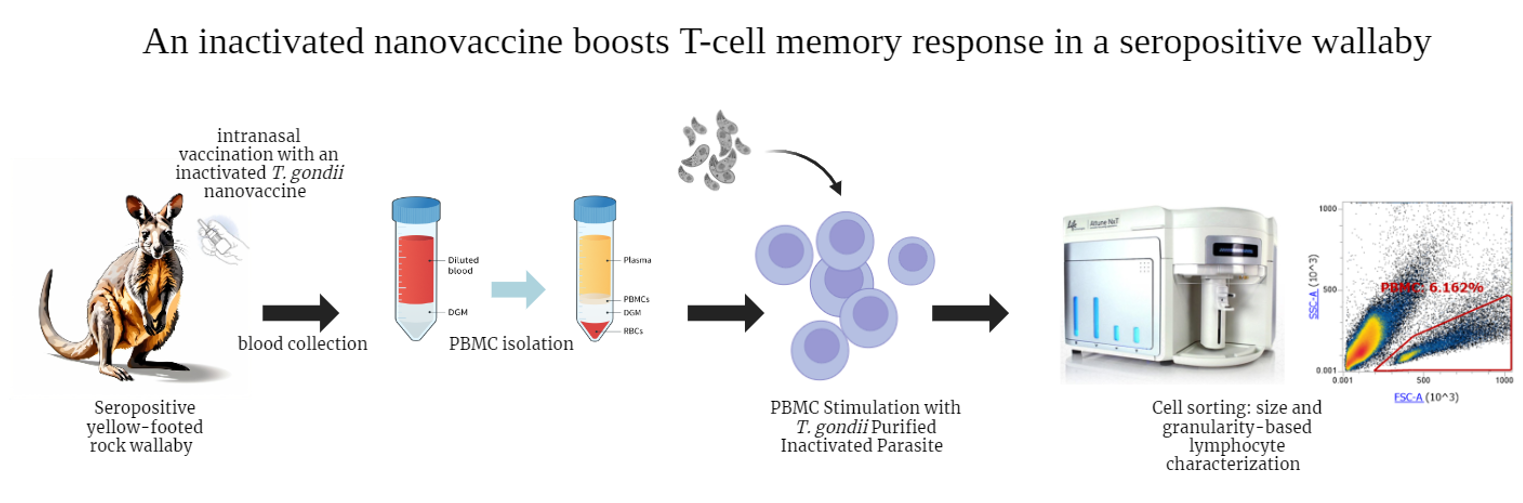
Abstract
Introduction
Toxoplasma gondii is a widespread protozoan parasite considered to be one of the most common agents of zoonotic infections in humans (Dubey, 2021, p. 202). The parasite can infect virtually any warm-blooded species, but the sexual phase of its reproductive cycle is restricted to felids. Cats are the definitive hosts of the parasite, and other animals get infected as intermediary hosts. Among these intermediary hosts, some species, such as Old World primates, rats, cattle, and horses are relatively resistant, while others, i.e. macropods and other marsupials, ring-tailed lemurs, squirrel monkeys, meerkats, and Pallas’ cats are extremely vulnerable to the infection (Denk et al., 2022). It is hypothesized that their vulnerability originates from their evolution separate from the parasite, making their immune responses maladapted to combat T. gondii infection efficiently. The data on T. gondii prevalence in wild Australian marsupials is scarce (Hillman et al., 2016), as clinical toxoplasmosis is rarely observed in free-ranging marsupials (Dubey et al., 2021). One report documents neurological problems and sudden death in a colony of allied rock wallabies (Petrogale assimilis) living in a peri-urban area of Magnetic Island, Australia (Bowater et al., 2024). The mortality was attributed to T. gondii and the outbreak of toxoplasmosis on the island was likely caused by an increased population of domestic cats in the area. Mortality in captive macropods is very common as documented in zoological parks and reserves in the United States (Guthrie et al., 2017; Spriggs et al., 2020; Anderson and Dennis, 2022), Argentina (Basso et al., 2007), Spain (Bermúdez et al., 2009; Fernández-Aguilar et al., 2013), and Hungary (Sós et al., 2012) […]
👉Link to the publication in International Journal of Parasitology